

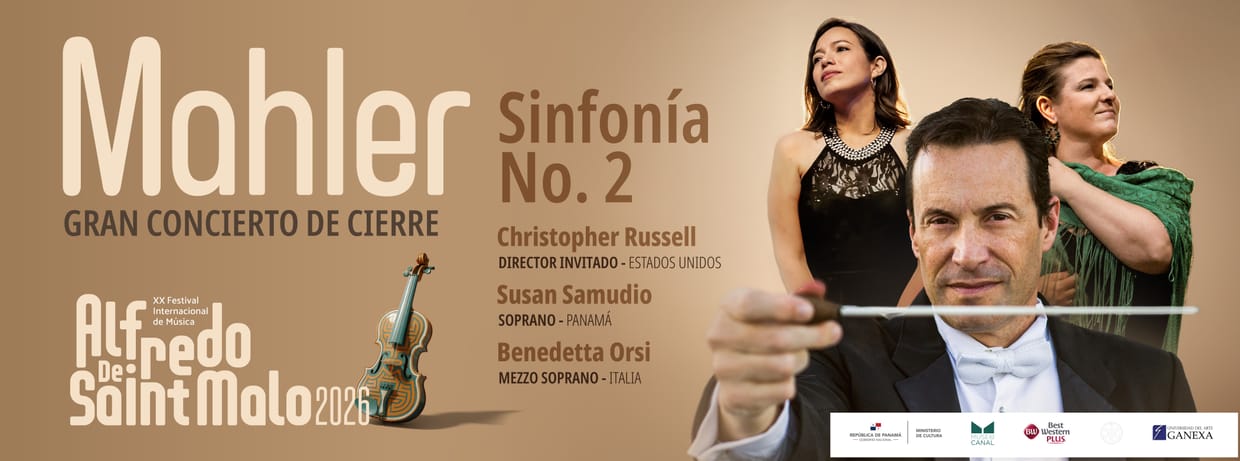
ASFM- GRAN GALA DEL FESTIVAL: LA RESURRECCIÓN DE MAHLER
Gran Gala del Festival: La Resurrección Mahler
Orquesta y Coro del Festival Alfredo Saint Malo
Sabado 25 de Julio
TEATRO BALBOA 7:00 p.m.
La Sinfonía n.º 2 en do menor “Resurrección” es una de las obras más monumentales y trascendentales del compositor austrohúngaro Gustav Mahler. Escrita entre 1888 y 1894, marca un punto de inflexión en su producción artística por su ambición sonora, su profundidad filosófica y su poderosa dimensión espiritual.
Mahler comenzó a trabajar en el primer movimiento en 1888 bajo el título Totenfeier (“Ritos fúnebres”), concebido inicialmente como un poema sinfónico independiente. Sin embargo, la obra fue creciendo hasta transformarse en una sinfonía de cinco movimientos. Durante varios años, el compositor buscó una forma adecuada para cerrar la obra, hasta que en 1894, en el funeral del director Hans von Bülow, escuchó el himno “Aufersteh’n” del poeta Friedrich Klopstock. Ese texto le ofreció la clave espiritual que necesitaba y lo llevó a componer el imponente final coral, ampliando los versos originales con palabras propias.
La sinfonía explora un recorrido existencial que va desde la angustia y el dramatismo inicial —casi una marcha fúnebre— hasta la afirmación luminosa de la vida eterna. Los movimientos intermedios ofrecen contrastes líricos y reflexivos, mientras que el quinto movimiento incorpora coro y solistas en un clímax de gran intensidad emocional. Este uso de la voz humana dentro de la estructura sinfónica, junto con una orquestación expansiva y contrastes extremos de dinámica y textura, refuerza el mensaje trascendental de la obra.
En el contexto del romanticismo tardío y del clima espiritual del fin de siglo europeo, la “Resurrección” refleja las inquietudes metafísicas de su tiempo: la crisis de fe, el temor ante la muerte y la esperanza de redención. Estrenada completa en 1895 en Berlín bajo la dirección del propio Mahler, la obra tuvo una recepción inicial diversa, pero con el tiempo se consolidó como una de las sinfonías más impactantes y profundas del repertorio orquestal. Más que una simple composición sinfónica, la “Resurrección” es una experiencia sonora que encarna la lucha humana entre la desesperación y la esperanza.
Grand Festival Gala: Mahler's Resurrection
Alfredo Saint Malo Festival Orchestra and Choir
Symphony No. 2 in C minor “Resurrection” is one of the most monumental and transcendent works of the Austro-Hungarian composer Gustav Mahler. Written between 1888 and 1894, it marks a turning point in his artistic output due to its sonic ambition, philosophical depth, and powerful spiritual dimension.
Mahler began working on the first movement in 1888 under the title Totenfeier (“Funeral Rites”), originally conceived as an independent symphonic poem. However, the work gradually expanded into a five-movement symphony. For several years, the composer searched for an appropriate way to conclude the piece, until in 1894, at the funeral of the conductor Hans von Bülow, he heard the hymn “Aufersteh’n” by the poet Friedrich Gottlieb Klopstock. That text provided the spiritual key he needed and led him to compose the imposing choral finale, expanding the original verses with his own words.
The symphony traces an existential journey that moves from anguish and initial drama—almost a funeral march—to the radiant affirmation of eternal life. The intermediate movements offer lyrical and reflective contrasts, while the fifth movement incorporates chorus and soloists in a climax of great emotional intensity. This use of the human voice within the symphonic structure, together with expansive orchestration and extreme contrasts of dynamics and texture, reinforces the transcendent message of the work.
Within the context of late Romanticism and the spiritual climate of fin-de-siècle Europe, the “Resurrection” reflects the metaphysical concerns of its time: the crisis of faith, the fear of death, and the hope of redemption. Premiered in full in 1895 in Berlin under Mahler’s own direction, the work initially received a mixed reception, but over time it became established as one of the most powerful and profound symphonies in the orchestral repertoire. More than a simple symphonic composition, the “Resurrection” is a sonic experience that embodies the human struggle between despair and hope.